How to Digitize Double-Sided Cursive Recipe Cards Accurately
This case study details the transcription hurdles of an idiosyncratic 1950s cursive hand featuring distinctive looped glyphs and shorthand fractions, demonstrating how multimodal vision AI resolves layout and character confusion across double-sided recipe cards.
📷 Physical Artifact & Archival Condition
Verified Archival Scan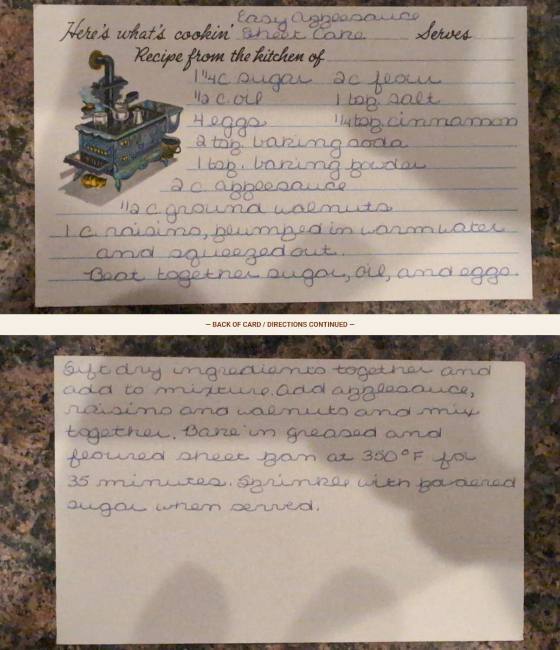
Key Handwriting & Physical Friction Points:
- •Unusual rounded letterforms where 'p' resembles 'z' and 'k' mimics 'r' (e.g., 'applesauce' looking like 'azzlesauce')
- •Tight condensed two-column ingredient layout that causes conventional OCR line mergers
- •Handwritten fraction notations written as shorthand (e.g., 1'4c for 1 1/4 cups and '1/2 c. oil)
- •Continuation of method instructions across the reverse card face without contextual headers
Historical Provenance & Recipe Origin
Found in an inherited tin box from a mid-century home, this pre-printed 'Here\'s what\'s cookin'' card features an illustrated wood-burning stove motif alongside a meticulous mid-century homemaker's script. Written for church potlucks and harvest dinners, this Easy Applesauce Sheet Cake was designed to feed a crowd quickly. The author's unique handwriting style—particularly her rounded descenders and informal fraction marks—makes it a quintessential example of family documents that defy traditional OCR tools.
Three Critical Friction Points on Looped Cursive Index Cards
1 Idiosyncratic Letterforms and Pseudo-Glyphs
The writer uses an atypical pen stroke for lowercase 'p', omitting the ascender stem and creating a double-looped bottom that standard OCR packages almost universally classify as 'zz'. Similarly, her lowercase 'b' and 'k' in 'baking' blend into ambiguous arches.
Card Excerpt: “'Easy applesauce' in the header repeatedly reads as 'Easy azzlesauce', while 'Bake' reads as 'Bare'.”
2 Dual-Column Ingredient Splitting
To fit twelve ingredients on a single side, the writer created two parallel columns without a dividing rule. Standard OCR processes line-by-line horizontally across the entire width, merging independent lines into unparseable combinations.
Card Excerpt: “'1 1/4 c. sugar' and '2 c flour' get merged horizontally into '1 1/4 c. sugar 2 c flour 1/2 c. oil 1 tsp. salt'.”
3 Shorthand Fraction Punctuation
Rather than standard typographical slashes (1/4), the writer uses tick marks and floating apostrophes like '1''4c' or omitting the leading digit separator, confusing rules-based unit parsers.
Card Excerpt: “'1''4c. sugar' and '1'4 tsp. cinnamon' require domain-aware contextual recognition to resolve as quarter-cup measurements.”
✨ How Unscribble Parsed Idiosyncratic Script and Split-Card Layouts
Unscribble's specialized recipe extraction pipeline approaches handwriting holistically. Rather than evaluating individual glyphs in isolation, the vision-language model combines culinary context with spatial geometry. Recognizing that 'azzlesauce' is nonsensical in a baking context, the model cross-references the ingredient list ('2 c. applesauce') to resolve the character ambiguity. Furthermore, Unscribble automatically isolates dual-column structures before parsing, preserving ingredient quantities, and stitches the front and reverse images into a single continuous recipe schema.
Step-by-Step Archival Transcription & Digitization Workflow
-
Step 1
Photograph Both Sides in Parallel Lighting
Place the card on a high-contrast, flat surface. Use diffused overhead natural light to avoid casting harsh shadows or creating glare from ballpoint ink indentations.
Archivist Pro Tip: Avoid camera angles; shoot directly perpendicular to prevent trapezoidal distortion.
-
Step 2
Capture Front and Back in a Single Session
Take high-resolution photos of both sides under identical lighting conditions so contrast and white balance remain uniform across the transcription batch.
Archivist Pro Tip: Ensure the top edge of each side is oriented upright to assist automatic orientation detection.
-
Step 3
Upload to Unscribble's Multi-Page OCR Pipeline
Upload both images together into Unscribble. The system segments the columns, interprets the handwriting quirks, normalizes shorthand measurements, and compiles instructions into standardized steps.
Archivist Pro Tip: Review the live editor view to confirm automated conversion of non-standard fractions.
-
Step 4
Export Structured Data
Save your digitized heirloom directly to your digital cookbook library, JSON, or print-ready PDF formats with metadata and original scans preserved.
Archivist Pro Tip: Keep original high-res scans attached to the digital record for genealogical preservation.
Easy Applesauce Sheet Cake
🥣 Ingredients
- • 1 1/4 cups sugar
- • 1/2 cup oil
- • 4 eggs
- • 2 cups flour
- • 1 tsp salt
- • 1 1/4 tsp cinnamon
- • 2 tsp baking soda
- • 1 tsp baking powder
- • 2 cups applesauce
- • 1/2 cup ground walnuts
- • 1 cup raisins, plumped in warm water and squeezed out
- • Powdered sugar, for serving
🍳 Preparation & Cooking Directions
- 1 1. Preheat oven to 350°F (175°C). Grease and flour a sheet pan.
- 2 2. Beat together sugar, oil, and eggs until well combined.
- 3 3. Sift dry ingredients together (flour, salt, cinnamon, baking soda, and baking powder) and add to the egg and sugar mixture.
- 4 4. Add applesauce, plumped raisins, and ground walnuts, mixing together until just combined.
- 5 5. Spread batter evenly into the prepared greased and floured sheet pan.
- 6 6. Bake at 350°F for 35 minutes or until a toothpick inserted into the center comes out clean.
- 7 7. Allow to cool, then sprinkle with powdered sugar when served.
Chef Technique & Notes:
- ✓Plumping raisins in hot water or warm apple cider prevents them from pulling moisture away from the cake batter during baking.
- ✓Be sure not to overmix the batter once the flour and applesauce are introduced, keeping the crumb soft and tender.
- ✓Use unsweetened applesauce for the best balance of sweetness and cinnamon spice flavor.
🏛️ Museum-Grade Physical Paper Preservation Tips
- • Store the card in an acid-free, lignin-free archival polyester (Melinex or archival poly) sleeve to stop skin oils from degrading the paper.
- • Keep index cards flat in a temperature-controlled space between 65°F and 70°F with 30-50% relative humidity; avoid damp basements or hot attics.
- • Never use adhesive tape, laminated plastic, or rubber bands on heirloom paper cards, as the adhesives chemically destroy cellulose over time.