How to Digitize Newspaper Recipe Clippings: 1958 Lemon Meringue Pie
Millions of family recipes survive as yellowed newspaper clippings folded inside cook books. We detail how to overcome newsprint paper fragility, reverse-side ink bleed, and column layout shifts.
📷 Physical Artifact & Archival Condition
Verified Archival Scan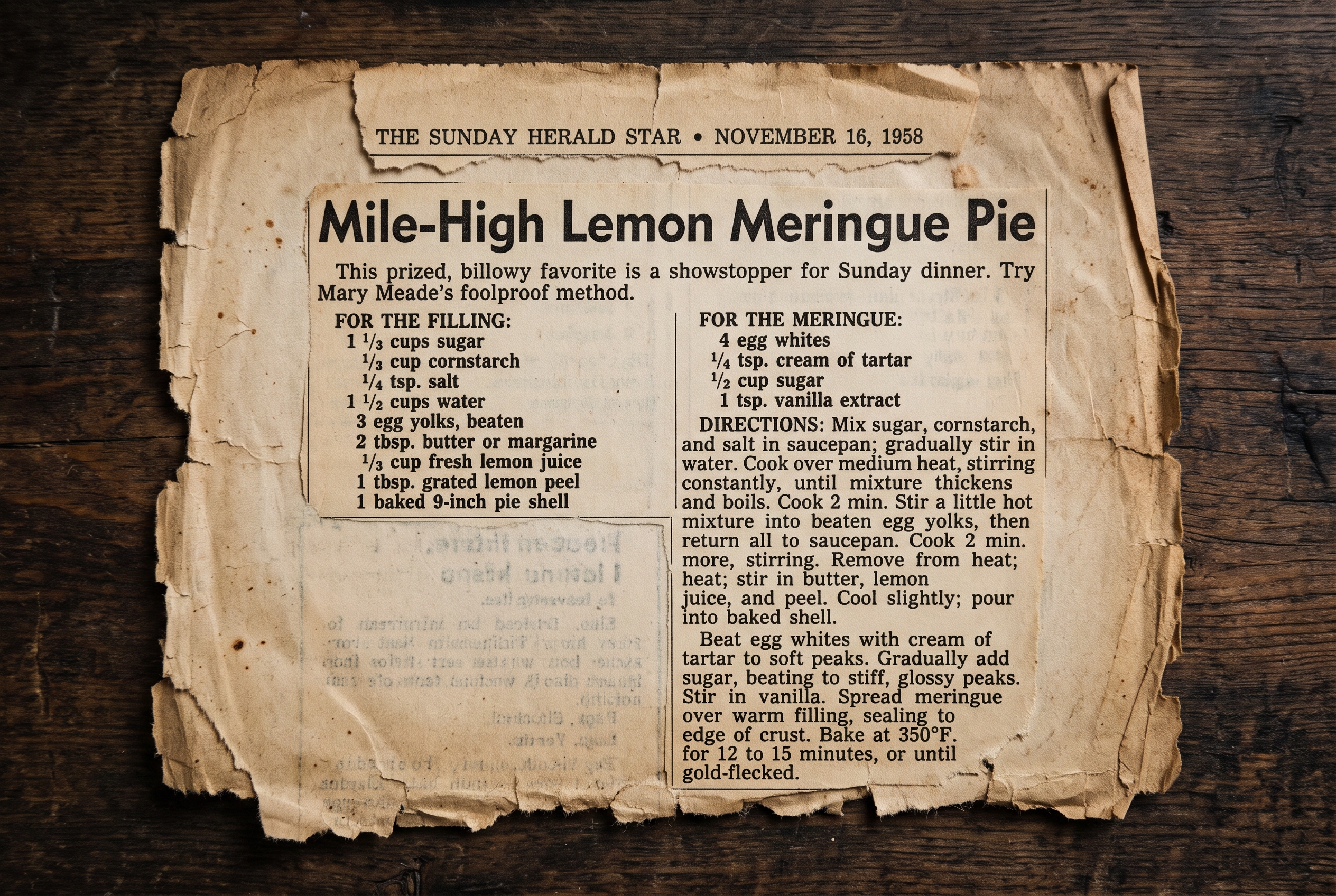
Key Handwriting & Physical Friction Points:
- •Reverse-side printing bleed-through creating ghost text behind the recipe ingredients
- •Multi-column newspaper layout with narrow 2-inch columns breaking fractions across lines
- •Micro-typography serif fonts with merged character pairs ('rn' looking like 'm', 'cl' looking like 'd')
- •Torn paper edge cutting off oven temperature on the final step
Historical Provenance & Recipe Origin
Newspaper clipping was the primary way home cooks collected recipes between 1920 and 1980. Made from cheap wood-pulp paper containing lignin, newspaper rapidly yellows and becomes brittle with age. This 1958 Sunday Herald Star clipping had torn edges, tight print gutters, and grocery store ads bleeding through from the back.
Challenges Specific to Newsprint Preservation
1
2
✨ Intelligent Column Parsing & De-Bleeding
Unscribble treats newspaper clippings as structured editorial typography. It identifies the headline, byline, ingredient section, and body copy independently, preserving the original culinary context while rendering clean modern typography.
Step-by-Step Archival Transcription & Digitization Workflow
-
Step 1
Flatten Against Neutral Background
Lay the brittle clipping flat on a dark or black matte backing sheet. Do not use weights on torn corners.
Archivist Pro Tip: Diffuse room light avoids harsh shadows along torn paper perimeters.
-
Step 2
Capture and Process with AI
Upload the photo to Unscribble. Vision models resolve column breaks and reconstruct missing margin words.
Archivist Pro Tip: The AI checks cooking times against classic mid-century culinary standards.
-
Step 3
Permanent Digital Archive
Review the digitized pie recipe and add personal family memories to the notes field.
Archivist Pro Tip: Create an AI dish presentation photo for your recipe collection.
1958 Mile-High Lemon Meringue Pie
🥣 Ingredients
- • 1 pre-baked 9-inch blind-baked flaky pie shell
- • 1½ cups granulated cane sugar, divided (1 cup for filling, ½ cup for meringue)
- • ⅓ cup cornstarch
- • ¼ tsp salt
- • 1½ cups boiling water
- • 4 large egg yolks, lightly beaten (reserve whites for meringue)
- • ½ cup freshly squeezed lemon juice (from 3 fresh lemons)
- • 1 tbsp finely grated lemon zest
- • 2 tbsp unsalted butter
- • 4 large egg whites, room temperature
- • ½ tsp cream of tartar
🍳 Preparation & Cooking Directions
- 1 In a heavy saucepan, whisk 1 cup sugar, cornstarch, and salt. Gradually whisk in boiling water. Cook over medium heat, stirring constantly, until mixture boils and becomes thick and translucent (2 mins).
- 2 Slowly temper 1/2 cup of hot mixture into the beaten egg yolks, then return all to saucepan. Simmer 1 minute while stirring constantly.
- 3 Remove from heat. Stir in lemon juice, lemon zest, and butter until completely melted and smooth. Pour immediately into the warm pre-baked pie shell.
- 4 In a clean glass or metal bowl, beat egg whites with cream of tartar until soft peaks form.
- 5 Gradually beat in the remaining 1/2 cup sugar (1 tablespoon at a time) on high speed until stiff, glossy peaks form and sugar is completely dissolved.
- 6 Spread meringue over hot filling, sealing completely to the crust edges all the way around to prevent weeping or shrinkage during baking.
- 7 Bake at 350°F for 12 to 15 minutes until meringue peaks are golden brown. Cool at room temperature for 2 hours before slicing with a wet chef knife.
Chef Technique & Notes:
- ✓Spreading the meringue onto the hot filling is the secret to preventing watery weeping underneath the meringue.
- ✓Be sure to seal meringue completely to the crust rim on all sides so it does not shrink inward while baking.
🏛️ Museum-Grade Physical Paper Preservation Tips
- • Lignin in newsprint generates acid as it decays; keep clippings away from heirloom photo paper.
- • Store clippings in archival buffered polypropylene sleeves with a pH between 7.5 and 8.5.
- • Digitizing creates an unalterable permanent cloud copy so brittle originals can rest safely in storage.