How to Digitize Cursive Recipe Cards: 1950s Spit-Roast Chicken
This case study demonstrates how to digitize rounded, idiosyncratic mid-century cursive handwriting across a double-sided vintage index card without mistranscribing vintage abbreviations or losing structural directions.
📷 Physical Artifact & Archival Condition
Verified Archival Scan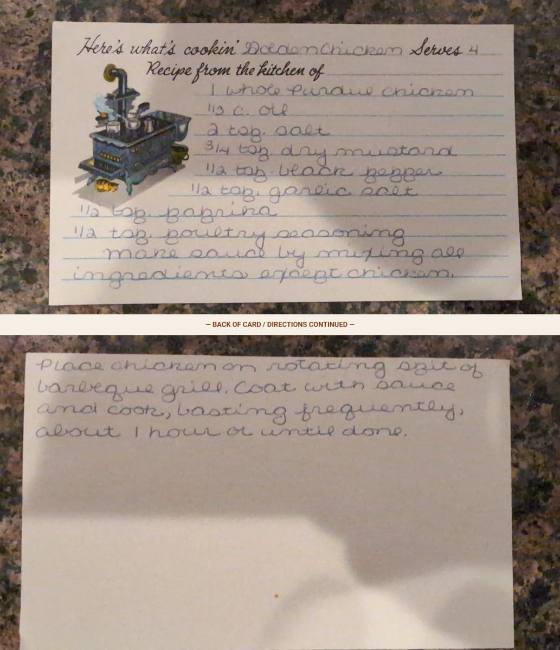
Key Handwriting & Physical Friction Points:
- •Unconventional lowercase looped cursive where 'tsp.' resembles 'tsb.' or 'tob.' due to oversized cursive b/p stems
- •Non-standard cursive letters such as 'k' appearing like capital 'R' or 'h' in words like 'black' and 'chicken'
- •Double-sided layout splitting prep instructions across the card face and back
- •Deciphering specific brand name marginalia and fractions written closely against pre-printed index lines
Historical Provenance & Recipe Origin
Found tucked inside a mid-century recipe tin, this recipe for 'Golden Chicken' captures the dawn of post-war backyard rotisserie grilling. Penned on a charming pre-printed card illustrated with an antique cast-iron stove, the card specifies a 'Perdue chicken' basted with an oil-and-spice rub over an open barbecue spit. The handwriting belongs to a family cook with distinctive, rhythmic, looped penmanship that blends standard Palmer cursive with quirky personal letterforms.
Three Critical Friction Points on Looped Cursive Cards
1 The 'tsp' vs 'tob' Lowercase Loop Confusion
Standard optical character recognition models rely on strict typographic baselines. In this artifact, the author terminates the abbreviation for teaspoon ('tsp.') with a rounded, high loop on the letter 'p', creating a glyph that traditional OCR parsers misread as 'tob.', 'top.', or an archaic measurement like 'tablespoon' (Tbsp).
Card Excerpt: “'1/2 tsp. black pepper' frequently digitizes as '112 tob. bleach pepper' in off-the-shelf OCR engines.”
2 Distinctive Mid-Century 'k' and 'z' Letterforms
The writer employs an open, arched loop on the lowercase 'k'—rendering 'chicken' and 'black' as 'chicRem' and 'bleacR'. Similarly, the letter 'p' in 'paprika' features a high ascending tail that intersects the ruled blue guideline, confusing edge-detection algorithms.
Card Excerpt: “The handwritten line '1 whole Perdue chicken' risks parsing as 'I whole Purdue chicrem'.”
3 Multi-Sided Execution Context
The card breaks the preparation across two distinct surfaces: the front lists the seasonings and initial mixture instruction, while the reverse holds the cooking technique on the rotisserie grill. Merging these disconnected photo uploads into a single structured schema requires semantic continuity.
Card Excerpt: “Direction 'make sauce by mixing all ingredients except chicken' terminates on the bottom front edge, while 'Place chicken on rotating spit' begins unnumbered on the reverse.”
✨ How Unscribble Transcribed the Card Without Error
Unscribble's multimodal vision model combines localized stroke analysis with culinary context libraries. When parsing the spice blend, the engine references standardized kitchen ratios alongside visual tokenization. Recognizing that salt, paprika, and poultry seasoning appear in fractional quantities (1/2, 3/4), the system resolves the ambiguous 'tob.' glyph to 'tsp.' automatically. Furthermore, Unscribble's multi-card collation capability merges front-and-back image captures into one unified recipe structure, isolating prep steps, ingredients, and rotisserie grill timings into clean, exportable digital fields.
Step-by-Step Archival Transcription & Digitization Workflow
-
Step 1
Capture Front and Back Under Diffused Light
Place the recipe card on a neutral, non-glare surface. Ensure overhead lighting is diffused to eliminate shadows cast across deep ink grooves and paper texture. Photograph both the front list and the back directions at a perpendicular 90-degree angle.
Archivist Pro Tip: Avoid smartphone camera flash, which washes out faint ballpoint ink strokes on aged, yellowed card stock.
-
Step 2
Upload Both Faces to Unscribble
Select the two images and upload them simultaneously. Unscribble detects paired front-and-back recipe cards and analyzes the visual typography across both scans simultaneously.
Archivist Pro Tip: Align the orientation before upload to ensure baseline text angle detection operates at maximum accuracy.
-
Step 3
Verify Semantic Measurements and Export
Review the parsed recipe preview. Confirm that specific brand mentions ('Perdue') and specialized equipment terms ('rotating spit', 'barbeque grill') are parsed into standard recipe schema blocks.
Archivist Pro Tip: Use Unscribble's one-click copy button to save the recipe straight to Markdown, JSON, or your favorite digital recipe organizer.
Golden Chicken
🥣 Ingredients
- • 1 whole Perdue chicken
- • 1/3 cup oil
- • 2 tsp. salt
- • 3/4 tsp. dry mustard
- • 1/2 tsp. black pepper
- • 1/2 tsp. garlic salt
- • 1/2 tsp. paprika
- • 1/2 tsp. poultry seasoning
🍳 Preparation & Cooking Directions
- 1 1. In a small bowl, make the basting sauce by thoroughly combining all ingredients except the chicken (oil, salt, dry mustard, black pepper, garlic salt, paprika, and poultry seasoning).
- 2 2. Secure the whole chicken onto the rotating spit of a barbecue grill.
- 3 3. Coat the chicken generously with the prepared basting sauce.
- 4 4. Cook on the rotisserie grill, basting frequently with the sauce, for about 1 hour or until done (internal temperature reaches 165°F in the thickest part of the thigh).
Chef Technique & Notes:
- ✓Truss the chicken tightly with butcher's twine before mounting on the spit to ensure it cooks evenly and doesn't flop around while rotating.
- ✓Use indirect heat on your barbecue grill to prevent the oil and spices from scorching before the bird is cooked thoroughly through to the bone.
- ✓Allow the chicken to rest for 10 to 15 minutes before carving to allow juices to redistribute back through the meat.
🏛️ Museum-Grade Physical Paper Preservation Tips
- • Store the physical index card in an acid-free, lignin-free buffered paper sleeve or polyester (Melinex/Mylar) pocket to prevent ongoing cellulose degradation.
- • Avoid laminating heirloom recipe cards; thermal lamination adhesives cause irreversible chemical yellowing and permanently bond with vintage ballpoint ink.
- • Keep stored cards away from high-humidity kitchen environments where grease droplets and moisture promote mold spores and paper cockling.
- • Handle delicate cards by the edges with clean, dry hands, or wear powder-free nitrile gloves to prevent transferring natural skin oils onto the card stock.