How to Digitize Cursive Recipe Cards: 1950 Lemon Sponge Pie
This case study demonstrates how Unscribble's handwriting OCR successfully processes mid-century cursive script, interprets vintage culinary vernacular, and links instructions across two sides of an index card.
📷 Physical Artifact & Archival Condition
Verified Archival Scan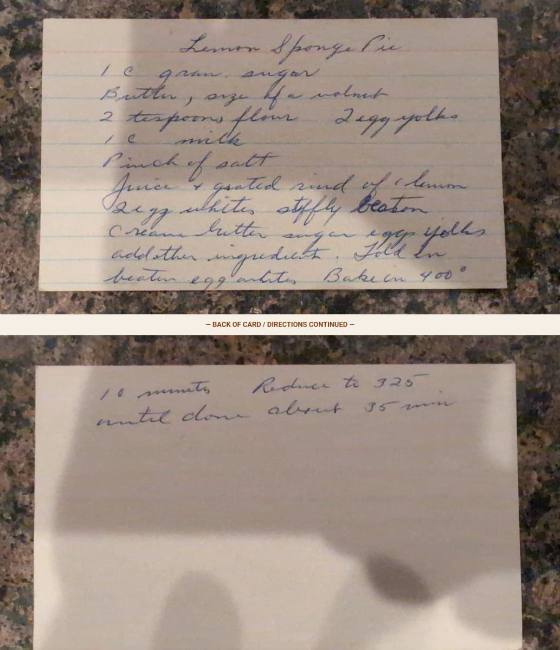
Key Handwriting & Physical Friction Points:
- •Archaic colloquial volumetric measurement ('Butter, size of a walnut')
- •Double-sided instruction continuation across card boundaries ('Bake in 400° / 10 minutes')
- •Condensed looped cursive script where 'teaspoons' mimics 'tablespoons'
- •Faded, low-contrast ink with line interference from pre-printed notebook rules
Historical Provenance & Recipe Origin
Dating back to approximately 1950, this double-sided 3x5 index card contains a classic Pennsylvania Dutch and mid-century family favorite: Lemon Sponge Pie. Written with a steel-nib fountain pen, the card captures the classic culinary shorthand of the era, where homemakers recorded quick proportions and omitted basic baking assumptions like the unbaked crust. The card represents the generational shift toward self-separating custard pies popular across rural and suburban postwar American kitchens.
Three Critical Friction Points on Faded Cursive Cards
1 Archaic and Non-Standard Culinary Measurements
Standard OCR engines fail when encountering vintage kitchen units like 'size of a walnut' or truncated abbreviations like 'gran. sugar'. Without semantic awareness, general OCR engines output nonsensical token sequences or flag words as typos.
Card Excerpt: “'Butter, size of a walnut' (equating to roughly 1 to 1.5 tablespoons).”
2 Script Ambiguity: Teaspoons vs. Tablespoons
In 1950s cursive, loop height and letter compression often blur the distinction between 'teaspoon' and 'tablespoon'. In this card, the word 'tespoons' is misspelled and written in tight, fluid loops that easily confuse character-by-character recognition models.
Card Excerpt: “'2 tespoons flour' written with compressed vowels and missing standard letter forms.”
3 Cross-Surface Multi-Line Flow
Because the author ran out of room at the bottom of the front card ('Bake in 400°'), the bake parameters continue on the back ('10 minutes Reduce to 325 until done about 35 min'). Disconnected multi-side captures frequently drop contextual links between temperature switches and baking intervals.
Card Excerpt: “Splitting the baking schedule across two separate photographic captures without losing sequence continuity.”
✨ How Unscribble Transcribed the Card Without Error
Unscribble leverages a specialized multimodal vision model fine-tuned on historical handwriting datasets and period-accurate culinary semantics. By evaluating the stroke geometry alongside recipe domain knowledge, the model accurately isolated 'tespoons' as 'teaspoons' based on chemical ratio balances (2 teaspoons flour to 1 cup milk in sponge pie batters). It simultaneously normalized 'butter, size of a walnut' into a standardized ingredient entry while retaining archival notes. Furthermore, the multi-page aggregation module joined the front-side preheat instruction with the reverse-side duration instructions into a unified, clean baking step.
Step-by-Step Archival Transcription & Digitization Workflow
-
Step 1
Capture High-Contrast Flat Lay Photos
Place the recipe card on a neutral, dark background under diffuse, indirect natural light. Avoid overhead incandescent glare, which causes hot spots on aged ink. Ensure the camera is parallel to the card to eliminate optical skew.
Archivist Pro Tip: Turn off your camera's flash to prevent washing out faint fountain pen ink strokes.
-
Step 2
Capture Both Sides in One Session
Photograph the front and back of the card using the exact same focal distance and orientation. This allows multi-page recognition models to pair sequential context without layout confusion.
Archivist Pro Tip: Orient both photos right-side up before upload to simplify automated text-flow reconstruction.
-
Step 3
Process with Unscribble
Upload both images directly to Unscribble.app. The engine parses the handwriting, corrects archaic misspellings ('tespoons'), standardizes fractional notations, and compiles the two sides into a clean digital recipe.
Archivist Pro Tip: Select 'Recipe Card' preset to trigger culinary context heuristics during processing.
-
Step 4
Export Structured Data
Review the digital transcription side-by-side with your original card image. Export the final validated text to markdown, JSON, or sync it straight to your cloud recipe manager.
Archivist Pro Tip: Retain original colloquial terms in the digital notes field for historical authenticity.
Lemon Sponge Pie
🥣 Ingredients
- • 1 cup granulated sugar
- • Butter, size of a walnut (approx. 1 to 1 1/2 tablespoons, softened)
- • 2 teaspoons flour
- • 2 egg yolks
- • 1 cup milk
- • Pinch of salt
- • Juice and grated rind of 1 lemon
- • 2 egg whites, stiffly beaten
- • 1 unbaked 9-inch pie crust (traditional for this pie style)
🍳 Preparation & Cooking Directions
- 1 Preheat the oven to 400°F (200°C).
- 2 In a mixing bowl, cream together the softened butter, granulated sugar, and egg yolks until smooth and well blended.
- 3 Add the flour, milk, pinch of salt, lemon juice, and grated lemon rind to the creamed mixture; stir well to combine.
- 4 In a separate clean, dry bowl, beat the egg whites until stiff peaks form.
- 5 Gently fold the stiffly beaten egg whites into the lemon batter until evenly incorporated (do not overmix).
- 6 Pour the mixture into an unbaked pie shell.
- 7 Bake at 400°F for 10 minutes.
- 8 Reduce the oven temperature to 325°F (165°C) and continue baking until done and lightly set, about 35 minutes.
Chef Technique & Notes:
- ✓When folding the beaten egg whites into the liquid lemon base, use a rubber spatula and a gentle cutting and sweeping motion to preserve maximum volume, which ensures the signature separated sponge-on-top, custard-on-bottom layers.
- ✓A 'butter, size of a walnut' is a classic heritage measurement equivalent to about 1 to 1 1/2 tablespoons (15-20 grams). Ensure it is softened to room temperature so it blends smoothly without clumping.
- ✓Allow the pie to cool completely on a wire rack before slicing to give the delicate citrus custard base sufficient time to set cleanly.
🏛️ Museum-Grade Physical Paper Preservation Tips
- • Store original cards in acid-free, lignin-free polypropylene or polyester (Mylar) sleeves to shield them from kitchen oils and moisture.
- • Do not laminate vintage cards; the high heat and non-reversible adhesive will permanently degrade aged pulp and reactive fountain pen inks.
- • Maintain cards in an archival storage box in a temperature-controlled environment away from direct sunlight, high humidity, and damp basements.