Digitize Double-Sided Recipe Cards: 1950s Corn Fritters OCR
This case study demonstrates how advanced multi-page handwriting OCR stitches separated front-and-back index cards into a single unified recipe, resolving mid-sentence line breaks and cursive quirks.
📷 Physical Artifact & Archival Condition
Verified Archival Scan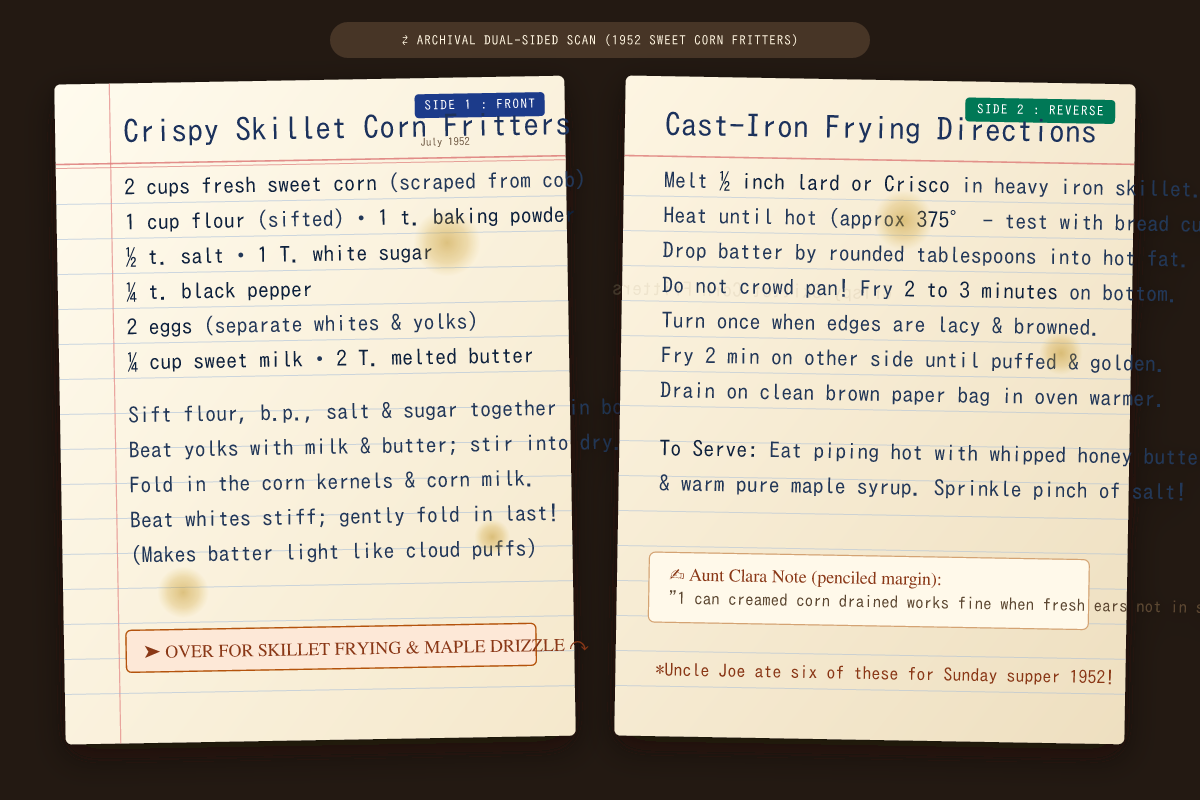
Key Handwriting & Physical Friction Points:
- •Cross-card word hyphenation ('table-' on front carrying over to 'spoonfuls' on back)
- •Faded, looped cursive letters that blend minims ('biscuit' written as 'bisquit', 'p' written like 'g')
- •Fractional spacing ambiguities in cursive ('2 1/3 c.') prone to OCR misalignment
- •Missing back-side header context requiring document reconstruction into unified JSON
Historical Provenance & Recipe Origin
Discovered in a mid-century recipe tin, this recipe card illustrates a classic post-war American staple: crispy corn fritters made with convenient canned goods and commercial baking mix. Authored on an illustrated 'Here's what's cookin'' card with a decorative cast-iron stove lithograph, the cook ran out of space on the front lines and naturally flipped the card over mid-sentence to complete the frying instructions on an unlined card back.
Three Critical Friction Points on Double-Sided Cursive Cards
1 Cross-Card Word Breaking and Semantic Splitting
Standard OCR engines evaluate images in total isolation. When a recipe card splits mid-word at the bottom edge with a hyphen ('Drop table-') and resumes on the reverse ('spoonfuls of batter'), single-image OCR creates fragmented, corrupt instructions unless multi-image context stitching is applied.
Card Excerpt: “Front ends with: 'Drop table-' / Back begins with: 'spoonfuls of batter into hot oil.'”
2 Looped Cursive Letter Confusions ('p' vs 'g' and 'q' vs 'g')
The author's cursive style produces descending loops that mimic other characters. The lower stem on 'Drop' resembles 'Drog', and the vintage spelling of 'bisquit mix' introduces non-standard vocabulary that trips up dictionary-based spellcheck algorithms.
Card Excerpt: “'Drop table-' visually mimics 'Drog table-', while 'bisquit mix' is commonly misread by OCR as 'biscuit mix' or 'bisquit mix' flagged as corrupted text.”
3 Unsegmented Ingredient and Unit Compounding
Cursive scripts often run numerals directly into units and fractions. On this card, the '2 1/3 c.' blends the fraction bar with the cup abbreviation, which standard document processing tools often misread as '21/3' or '2 13 c.'.
Card Excerpt: “'2 1/3 c. all purpose bisquit mix' misread by basic OCR tools as '213 c. all purpose'.”
✨ How Unscribble Transcribed the Card Without Error
Unscribble uses paired-image document processing to ingest both the recto (front) and verso (back) images concurrently. The visual transformer model recognizes edge-bound continuation tokens (such as trailing hyphens) and reconstructs the split instruction stream ('Drop table-' + 'spoonfuls') into a grammatically continuous instruction. Concurrently, our specialized culinary training dataset resolves ambiguous cursive ligatures—recognizing 'bisquit mix' as an intentional mid-century commercial variant for baking mix and properly parsing the fraction '2 1/3 c.' into distinct quantitative schema fields.
Step-by-Step Archival Transcription & Digitization Workflow
-
Step 1
Capture Front and Back in Identical Lighting
Place the card on a neutral, non-reflective flat surface. Take top-down photos of both sides without altering your light source or camera angle to preserve uniform color tone and contrast across both shots.
Archivist Pro Tip: Avoid handheld angled shots that create parallax distortion, which degrades handwriting stroke detection.
-
Step 2
Upload Both Images as a Multi-Page Record
Upload the front and back images together into Unscribble.app. Tag the uploads as Page 1 (Front) and Page 2 (Back) so the system initiates cross-card sequence reconstruction.
Archivist Pro Tip: Do not crop out edge hyphens or corner notes; border handwriting provides critical continuation markers.
-
Step 3
Review Automated Parsing and Export Structured Data
Verify the stitched instructions and structured ingredients in the interactive preview window, then export your standardized recipe to JSON, Markdown, or your favorite recipe manager.
Archivist Pro Tip: Look specifically at fractional measurements like '2 1/3' to verify exact fractional encoding.
Corn Fritters
🥣 Ingredients
- • 1 (17 oz.) can corn (liquid reserved)
- • 1 large egg
- • 2 1/3 cups all-purpose biscuit mix
- • Salad oil (enough for 2-3 inches deep in skillet)
- • Syrup (for serving)
🍳 Preparation & Cooking Directions
- 1 1. Heat 2 to 3 inches of salad oil to 375°F in a heavy skillet.
- 2 2. Pour liquid drained from the canned corn into a medium bowl.
- 3 3. Add the egg and biscuit mix to the corn liquid; stir until smooth.
- 4 4. Fold in the corn kernels.
- 5 5. Drop tablespoonfuls of batter into the hot oil.
- 6 6. Fry until golden brown, turning once.
- 7 7. Drain on paper towels and serve hot with syrup.
Chef Technique & Notes:
- ✓Maintain the oil temperature at 375°F using a deep-fry thermometer; oil that is too cool will make the fritters greasy, while oil that is too hot will burn the exterior before cooking through.
- ✓Do not overcrowd the skillet while frying, as this drops the oil temperature and prevents even browning.
- ✓For extra flavor, consider pairing with warm real maple syrup or honey butter.
🏛️ Museum-Grade Physical Paper Preservation Tips
- • Store double-sided index cards in archival-grade, acid-free polyester (Mylar) or polypropylene sleeves to protect against skin oils and kitchen splatters without obscuring the back side.
- • Do not laminate vintage recipe cards; thermal lamination causes irreversible chemical deterioration of the cellulose and accelerates ink migration.
- • Maintain cards in a temperature-controlled space below 70°F (21°C) with relative humidity between 30% and 50% to prevent warping and ink bleeding.