How to Digitize Handwritten Brewing Notebooks: Devil's Blood Wine
This case study demonstrates how Unscribble accurately parses informal kitchen notebook logs containing strike-through edits, mixed measurement systems, and technical brewing shorthand into structured digital formulas.
📷 Physical Artifact & Archival Condition
Verified Archival Scan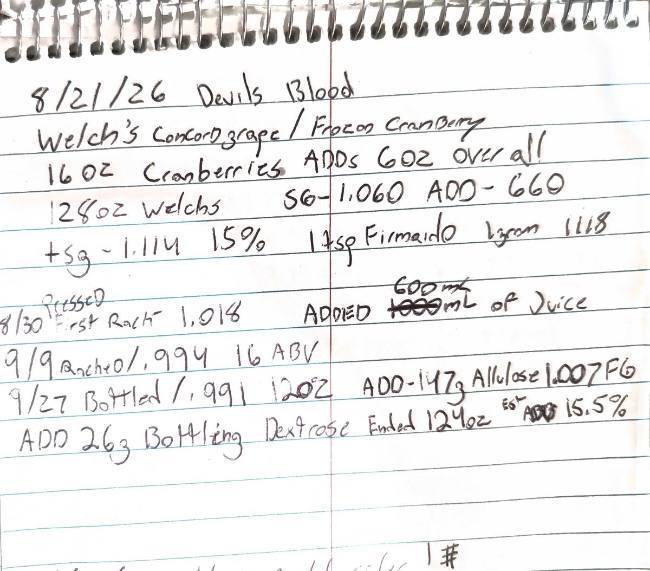
Key Handwriting & Physical Friction Points:
- •Overlapping strike-through corrections (e.g., '1000 mL' crossed out and replaced with '600 mL')
- •Technical abbreviations such as 'SG' (specific gravity), 'FG' (final gravity), and 'ABV' (alcohol by volume)
- •Non-standard measurement notations including mixed metric/imperial units ('128 oz', '660 g', '147g', '120 oz')
- •Casual cursive and rapid script blending numbers and units (e.g., '147g' resembling '1473', '2 gram 1118' condensed)
Historical Provenance & Recipe Origin
Brewing logs kept in wire-bound kitchen notebooks are working technical journals. Unlike display cookbooks, these pages document active experiments in real time, capturing incremental specific gravity drops, emergency juice top-offs, and tailored back-sweetening adjustments. The 'Devils Blood' log details an artisan concord grape and cranberry country wine fermented dry to 16% ABV using Lalvin EC-1118 yeast, complete with strike-through volume corrections and hydrometer checks written between racking dates.
Three Friction Points in Transcribing Kitchen Brewing Logs
1 Crossed-Out Figures and Overwritten Numbers
Standard optical character recognition models stumble when digits are crossed out or overwritten. On the 8/30 racking entry, the brewer originally logged 'ADDED 1000 mL of juice', subsequently striking out '1000 mL' with a horizontal line and penning '600 mL' directly above. Legacy OCR typically outputs 'ADDED 1000mL 600mL' or creates garbled nonsense strings.
Card Excerpt: “Reading '600 mL' correctly while ignoring the crossed-out '1000 mL' requires visual strike-through detection.”
2 Visual Ambiguity Between Unit Suffixes and Digits
Handwritten metrics written at speed often fuse the quantity and the unit symbol. The addition of '147g' of allulose appears visually similar to '1473' due to the tight descender on the letter 'g'. Standard text engines misinterpret this as 1,473 grams—an error that would completely destroy the flavor balance of a one-gallon batch.
Card Excerpt: “Discerning '147g' (147 grams) vs '1473' through domain-aware brewing heuristics.”
3 Inline Specific Gravity and Formulaic Shorthand
The log records vital brewing metrics inline: 'SG-1.060 ADD-660', '+sg-1.114 15%', and '9/9 Racked .994 16 ABV'. Generic OCR lacks the brewing vocabulary required to understand that 'SG' stands for specific gravity, '+sg' indicates target adjusted gravity, and decimal values near 1.000 are critical density parameters rather than arbitrary timestamps or page numbers.
Card Excerpt: “Preserving the decimal alignment of gravity readings (1.060, 1.018, 0.994, 0.991) against journal timestamps.”
✨ How Unscribble Resolves Kitchen Notebook Shorthand
Unscribble utilizes multi-modal document vision models engineered specifically for culinary, fermentation, and domestic logs. When analyzing the Devil's Blood card, the model detects strikethrough strokes as deliberate deletions, extracting '600 mL' as the authoritative value while logging '1000 mL' as superseded historical text. By applying domain-specific contextual priors for winemaking and baking, Unscribble interprets ambiguous descenders like 'g' in '147g' alongside chemical and brand terminology such as 'Fermaid O', 'Lalvin 1118', and 'Allulose'.
Step-by-Step Archival Transcription & Digitization Workflow
-
Step 1
Flatten and Secure Spiral Notebook Margins
Place the spiral-bound notebook on a level surface. Keep pages flat using clean archival acrylic weights, avoiding shadows cast by spiral wire coils.
Archivist Pro Tip: Position the camera directly overhead parallel to the paper surface to prevent perspective keystoning of tight handwriting lines.
-
Step 2
Illuminate Lined Paper to Avoid Shadow Banding
Use balanced, diffused light from two opposing 45-degree angles. This eliminates shadows inside paper creases and prevents ruled notebook lines from obscuring light pencil or pen strokes.
Archivist Pro Tip: Turn off high-contrast directional flash, which creates hot spots on glossy ballpoint inks.
-
Step 3
Upload to Unscribble for Semantic Interpretation
Upload the uncropped high-resolution JPG or PNG directly into Unscribble, selecting the Kitchen Notebooks & Brewing Logs pipeline to preserve structural timelines and crossed-out notes.
Archivist Pro Tip: Inspect the digitized preview for struck-out annotations to ensure adjustments are accurately reflected in the final digital recipe.
Devil's Blood Concord-Cranberry Wine
🥣 Ingredients
- • 128 oz Welch's 100% Concord Grape Juice (without preservatives like potassium sorbate)
- • 16 oz frozen cranberries
- • 660 g granulated sugar (or brewing dextrose) for initial gravity adjustment
- • 1 tsp Fermaid O (yeast nutrient)
- • 2 g Lalvin EC-1118 wine yeast
- • 600 mL Welch's Concord Grape Juice (for racking top-off / stabilization)
- • 147 g allulose (for non-fermentable back-sweetening)
- • 26 g dextrose / priming sugar (for carbonation, if bottle conditioning)
🍳 Preparation & Cooking Directions
- 1 1. Sanitize all fermentation equipment, airlocks, carboys, and utensils thoroughly.
- 2 2. Thaw and lightly crush or press the 16 oz of frozen cranberries (estimated liquid volume addition is approximately 6 oz).
- 3 3. Combine the 128 oz Welch's Concord grape juice with the crushed cranberries and 66 g sugar in a sanitized primary fermenter. Check specific gravity (starting SG should be around 1.060 prior to sugar addition, adjusting target starting gravity to approximately 1.114, representing ~15% potential ABV).
- 4 4. Rehydrate 2 g Lalvin EC-1118 yeast according to manufacturer guidelines and pitch into must alongside 1 tsp Fermaid O.
- 5 5. Seal fermenter with an airlock and ferment at cool room temperature (65°F–72°F / 18°C–22°C). Monitor specific gravity progression.
- 6 6. At approximately day 9 (when SG drops to ~1.018), press the fruit skins, rack the wine off the gross lees into secondary fermentation, and top off with 600 mL concord grape juice.
- 7 7. Allow fermentation to finish dry. Check specific gravity (target terminal gravity is ~0.994–0.991, yielding approximately 16% ABV).
- 8 8. Rack the cleared wine (yielding ~120 oz). Back-sweeten with 147 g allulose to achieve a balanced final gravity feel of ~1.007 FG without restarting fermentation.
- 9 9. Blend in 26 g dextrose priming sugar thoroughly if light effervescence/bottle conditioning is desired, ending with ~124 oz total volume and an estimated 15.5% finished ABV.
- 10 10. Bottle into sanitized wine or pressure-rated bottles, cork or cap tightly, and cellar in a cool, dark location.
Chef Technique & Notes:
- ✓Ensure commercial juices contain no preservatives such as potassium sorbate or sodium benzoate, as they will inhibit yeast reproduction and stall primary fermentation.
- ✓Allulose acts as a rare sugar that yeast cannot ferment, providing natural roundness and perceived residual sweetness without requiring chemical stabilization (potassium metabisulfite/sorbate) prior to back-sweetening.
- ✓If using dextrose for natural carbonation alongside non-fermentable allulose, strictly bottle in heavy-gauge crown-capped beer bottles or champagne bottles to handle internal carbonation safely.
🏛️ Museum-Grade Physical Paper Preservation Tips
- • Store spiral notebooks in acid-free, buffered archival manuscript folders rather than standard plastic sleeves that can attract ink via static cling.
- • Avoid storing notebooks in humid kitchen or cellar spaces where condensation causes mold and ballpoint ink feathering.
- • Keep raw paper notebooks away from direct UV sunlight to prevent yellowing of wood-pulp paper and fading of dye-based ballpoint inks.