Digitize Handwritten Brew Logs: White Raspberry Wine Recipe
This case study details the automated transcription and digital preservation of a dense, handwritten homebrewing log filled with technical gravity readings, mixed units, and interlinear notes.
📷 Physical Artifact & Archival Condition
Verified Archival Scan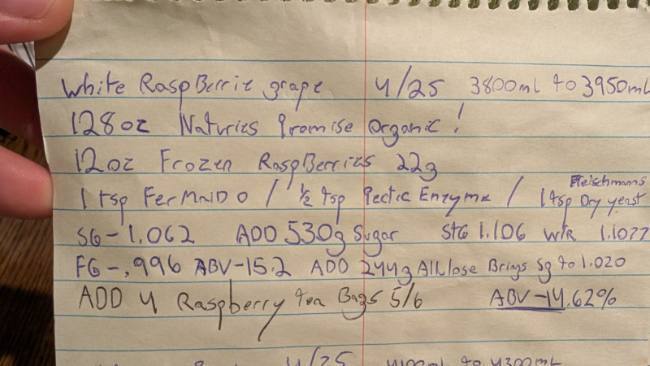
Key Handwriting & Physical Friction Points:
- •Dense technical fermentation jargon including shorthand abbreviations like SG, STG, FG, and ABV
- •Mixed case handwriting with inconsistent letter casing and numeric decimals (.996, 1.062, 14.62%)
- •Superscript marginalia and brand interlineations such as 'Fleischmann's' squeezed above line text
- •Mixed measurement frameworks combining metric grams and milliliters with imperial ounces and teaspoons
Historical Provenance & Recipe Origin
Scribbled hastily across yellow legal pad-style spiral notebook paper, this homebrew log tracks an artisanal small-batch White Raspberry Grape Wine. In the kitchen, winemaking logs are working documents: brewers jot down hydrometer readings, additions, dates, and brand names in real time with sticky fingers and hurried strokes. Recipes like this bridge functional chemistry and personal culinary expression, but their dense mathematical notations and idiosyncratic shorthand make them nearly impossible for standard document scanners to parse accurately.
Three Critical Friction Points on Handwritten Kitchen Notebook Logs
1 Decimals and Technical Metric/Imperial Units
Homebrewing records rely on tight decimal tolerances to calculate alcohol by volume. Standard optical character recognition tools frequently mistake leading decimals (like '.996') for errant specks or commas, and struggle with fluid changes between grams (530g, 22g), ounces (128oz, 12oz), and volume metrics (3800ml to 3950ml).
Card Excerpt: “'FG - .996 ABV - 15.2' can easily be misread by generic OCR as 'FG - ,996 ABV-152' or 'ABV-15.Z'.”
2 Superscript Brand Corrections & Floating Notes
When the maker noted yeast additions, they realized they forgot the specific brand, squeezing 'Fleischmanns' in tiny cursive directly over the slash separator and '1 tsp Dry yeast'. Traditional block-based OCR splits this into disconnected tokens or misattributes the placement entirely.
Card Excerpt: “The squeezed annotation 'Fleischmanns' floating above '/ 1 tsp Dry yeast' often ends up attached to the previous line or dropped altogether.”
3 Date and Gravity Log Formatting Across Vertical Margins
Unlike standard narrative recipes, logs combine recipe steps with timeline milestones. '4/25' sits at the top right alongside batch volume, while 'ADD 4 Raspberry tea Bags 5/6' marks a secondary dry-hop style infusion on May 6th, followed by post-sweetening specific gravity calculations.
Card Excerpt: “Misinterpreting '5/6' as a fraction (five-sixths) rather than an action date for adding tea bags.”
✨ How Unscribble Transcribed the Card Without Error
Unscribble utilizes context-aware vision models trained on culinary and archival handwriting. Instead of evaluating characters in isolation, the engine recognizes the semantic relationship of a fermentation record: it expects specific gravity (SG) to fall within standard hydrometer ranges (1.000 to 1.150) and understands that 'ABV' correlates mathematically to starting and final gravities. The vision model isolates interlinear marginalia like 'Fleischmann's' and assigns it hierarchically to the yeast ingredient slot, while properly resolving leading decimals, fractions, and slash separators across the notebook page.
Step-by-Step Archival Transcription & Digitization Workflow
-
Step 1
Flatten and Secure the Notebook Page
Place the notebook page on a clean, flat, dark background to provide border contrast against the torn spiral-ring perforations. Do not fold the page backward, as this introduces paper tension and shadow gradients.
-
Step 2
Eliminate Glare and Direct Shadows
Position diffused indirect daylight or twin 45-degree angle task lights over the paper. Ballpoint ink has slight reflectivity that can wash out under direct overhead flash.
Archivist Pro Tip: Keep your smartphone parallel to the paper plane to prevent keystone distortion of handwritten numbers.
-
Step 3
Upload to Unscribble with Scientific/Recipe Context
Run the raw image through Unscribble's document pipeline. The engine auto-detects line structures, distinguishes dates from fractions, and structures ingredients and gravity parameters cleanly.
Archivist Pro Tip: Review the extracted tabular preview to verify specific gravity readings before exporting to JSON or your recipe archive.
White Raspberry Grape Wine
🥣 Ingredients
- • 128 oz Nature's Promise Organic White Grape Juice
- • 12 oz Frozen Raspberries
- • 22 g Raspberries (additional)
- • 1 tsp Fermaid O yeast nutrient
- • 1/2 tsp Pectic Enzyme
- • 1 tsp Fleischmann's Dry Yeast
- • 530 g Granulated Sugar
- • 244 g Allulose (for back-sweetening)
- • 4 Raspberry Tea Bags
🍳 Preparation & Cooking Directions
- 1 Mise en place: Sanitize all fermentation equipment thoroughly. Combine the white grape juice and frozen raspberries in a primary fermentation vessel.
- 2 Add the Fermaid O, pectic enzyme, and dry yeast to the juice mixture. Ensure the initial specific gravity (SG) is approximately 1.062.
- 3 Incorporate 530g of granulated sugar to reach a target starting gravity (STG) of 1.106.
- 4 Allow the mixture to ferment until the final gravity (FG) reaches .996, resulting in an initial ABV of approximately 15.2%.
- 5 Add the 4 raspberry tea bags to the fermenter on May 6th to infuse flavor.
- 6 Stabilize and back-sweeten by adding 244g of Allulose, which will adjust the final specific gravity to 1.020 and result in a final ABV of 14.62%.
Chef Technique & Notes:
- ✓Always use a hydrometer to track your specific gravity; it is the only way to accurately calculate your final ABV.
- ✓Pectic enzyme is essential when working with fruit-based wines to prevent haze and ensure a clear final product.
- ✓When back-sweetening with non-fermentable sweeteners like Allulose, ensure the wine is fully stabilized to prevent re-fermentation.
🏛️ Museum-Grade Physical Paper Preservation Tips
- • Store acidic wood-pulp notebook paper in acid-free, lignin-free buffered archival paper folders to prevent yellowing and embrittlement.
- • Do not laminate notebook pages; heat-seal lamination irreversibly binds plastic to the fiber and degrades ballpoint ink over time.
- • Maintain home storage humidity below 55% RH to avoid ink transfer and paper mold in kitchen spaces.