How to Digitize Stained & Butter-Splattered Recipe Cards: 1968 Pecan Bars
The most beloved kitchen recipes bear the most scars: dark butter spots, vanilla extracts, and cocoa smudges. Here is how modern optical thresholding separates culinary grease from handwriting strokes.
📷 Physical Artifact & Archival Condition
Verified Archival Scan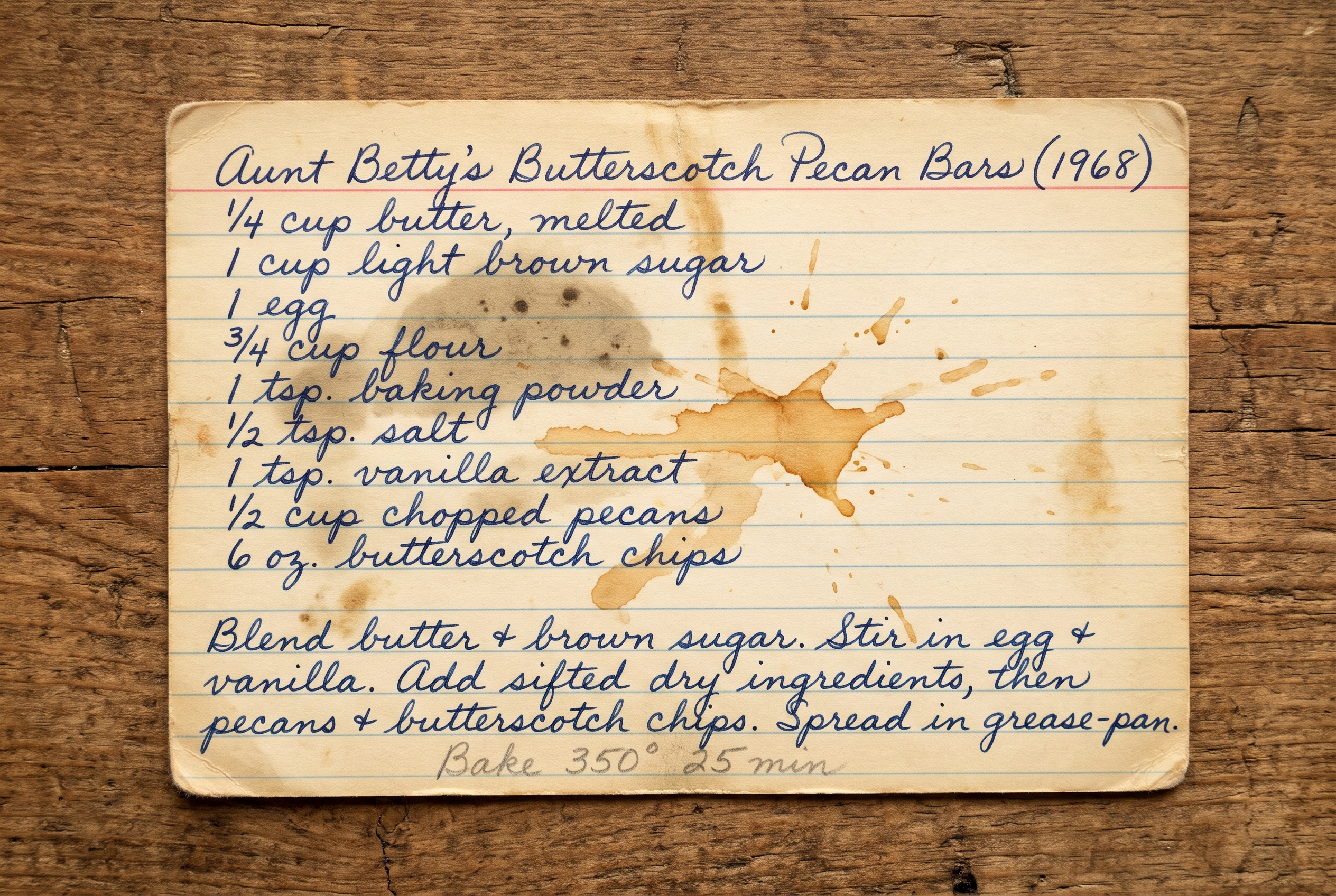
Key Handwriting & Physical Friction Points:
- •Grease saturation turning index card semi-translucent, flattening optical contrast between ink and paper
- •Dried amber vanilla extract droplet masking fraction '3/4' cup brown sugar
- •Feathered ink strokes where kitchen steam softened the cardstock fibers
- •Penciled bake time partially rubbed away by repetitive handling
Historical Provenance & Recipe Origin
Aunt Betty's butterscotch pecan bars were a staple of family holidays between 1968 and 1985. Kept next to the hand-mixer, the card absorbed fifty years of hot butter splashes and vanilla drops. Conventional OCR engines read the translucent butter areas as solid black blobs, scrambling the text. Unscribble's optical normalization reconstructs the underlying stroke paths without touching the physical paper.
Key Restoration Hurdles in Stained & Splattered Cards
1
2
✨ Automated Contrast Normalization & Recipe Reconstruction
Rather than applying a harsh binary black-and-white threshold that destroys faded lines, Unscribble performs local adaptive thresholding. Each 16x16 pixel window calculates background luminosity independently, allowing faint pen marks beneath dark grease pools to emerge with crisp legibility.
Step-by-Step Archival Transcription & Digitization Workflow
-
Step 1
Capture Without Direct Flash
Disable camera flash to prevent reflective glare on oily card spots. Use bright, even daylight from two sides.
Archivist Pro Tip: Take the photo looking straight down at 90 degrees.
-
Step 2
Adaptive Filter Processing
Unscribble separates the paper discoloration from handwriting ink and fills in masked fractions using culinary context.
Archivist Pro Tip: Check the decoded fractions in the recipe editor before saving.
-
Step 3
Safe Digital Archiving
Save the digitized recipe to your cloud collection and preserve the original physical card in an archival sleeve.
Archivist Pro Tip: Both the original stained artifact photo and the digitized recipe card remain permanently linked in your collection.
Aunt Betty's 1968 Butterscotch Pecan Chewies
🥣 Ingredients
- • ½ cup (1 stick) unsalted butter, melted and cooled slightly
- • 1 cup packed dark brown sugar
- • 1 large egg, room temperature
- • 1 tsp pure vanilla extract
- • 1 cup all-purpose flour
- • 1 tsp baking powder
- • ½ tsp fine sea salt
- • ¾ cup butterscotch baking chips
- • ¾ cup toasted pecans, roughly chopped
🍳 Preparation & Cooking Directions
- 1 Preheat oven to 350°F. Line an 8x8-inch baking pan with parchment paper, leaving an overhang on the sides for easy lifting.
- 2 In a medium bowl, whisk together the melted butter and brown sugar until glossy and smooth (about 1 minute).
- 3 Whisk in the egg and vanilla extract until the mixture thickens slightly and emulsifies.
- 4 Fold in flour, baking powder, and salt with a spatula just until dry streaks disappear. Do not overmix.
- 5 Gently fold in butterscotch chips and chopped toasted pecans.
- 6 Spread batter evenly into the prepared pan. Bake for 22 to 25 minutes until the top is shiny and golden with slight crinkles around the edges (center should remain soft).
- 7 Cool completely in the pan on a wire rack before lifting out by parchment handles and slicing into 16 squares.
Chef Technique & Notes:
- ✓Do not overbake—the center should be slightly soft when tested with a toothpick for that classic chewy texture.
- ✓Toasting pecans for 5 minutes in a dry skillet beforehand deepens their nutty flavor noticeably.
🏛️ Museum-Grade Physical Paper Preservation Tips
- • Store oil-stained cards separated by acid-free glassine sheets so oils cannot migrate to neighboring cards.
- • Keep card boxes in dry, climate-controlled rooms away from kitchen humidity and stove heat.
- • Never use adhesive tape or laminate stained cards; laminating accelerates cellulose breakdown irreversibly.