How to Transcribe Typewriter Recipe Cards: 1947 Pot Roast & Gingersnaps
Post-war kitchen cards typed on manual Remingtons or Royals carry unique mechanical artifacts: uneven hammer pressure, fading cloth ribbons, and strike-through annotations. Here is how modern OCR decodes them accurately.
📷 Physical Artifact & Archival Condition
Verified Archival Scan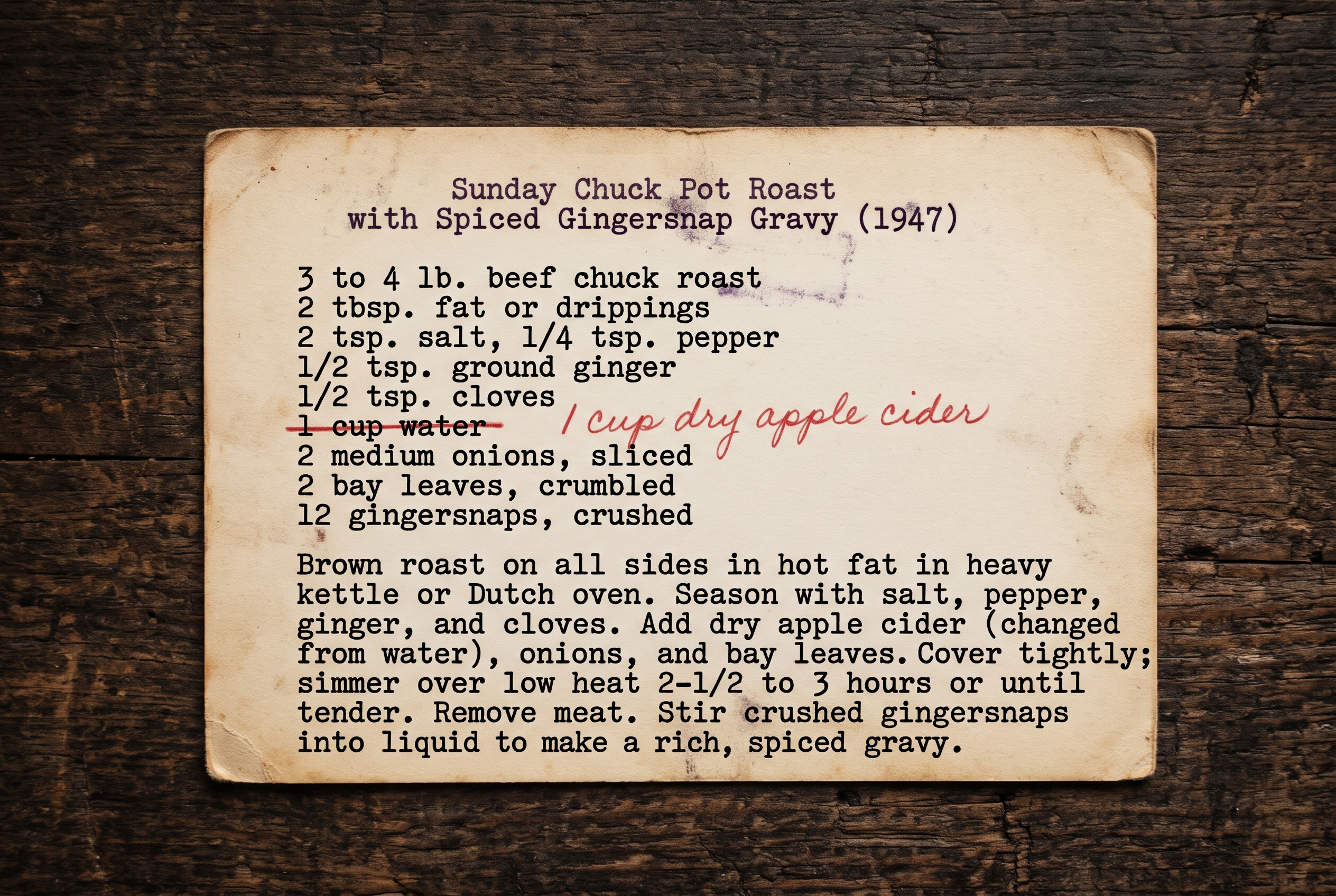
Key Handwriting & Physical Friction Points:
- •Faint mechanical key strikes on rounded vowels ('o', 'e', 'c') where ribbon was exhausted
- •Red pencil strike-through editing '1 cup water' to '1 cup dry apple cider'
- •Carbon copy smear across cooking duration numbers
- •Archaic abbreviation 'bx.' (box) vs 'bsh.' (bushel)
Historical Provenance & Recipe Origin
In 1947, newlyweds often typed recipe boxes as part of their domestic starter sets. As ribbons wore out, typists struck harder, leaving embossed indentations in the cardstock rather than dark ink. This German-American family pot roast card had faint purple lettering and a pencil correction substituting apple cider for water.
Mechanical Artifacts of 20th Century Typewriters
1
2
✨ Typographic Stroke Resolution & Revision Parsing
Unscribble incorporates specific character model matrices trained on vintage mechanical typewriter fonts. It accurately parses strike-through corrections without mistaking horizontal pen lines for hyphenation or minus signs.
Step-by-Step Archival Transcription & Digitization Workflow
-
Step 1
Capture the Card Surface
Position camera parallel to the card face. Even illumination reveals faint character outlines clearly.
Archivist Pro Tip: Ensure both typed text and hand-annotated pencil notes are in sharp focus.
-
Step 2
Multimodal Analysis
Unscribble parses the mechanical typeface, resolves strikes, and structures ingredients and directions.
Archivist Pro Tip: Review the parsed revision to verify the updated cider measurement.
-
Step 3
Cloud Backup
Sync directly to your Google Drive and export PDF cards ready for printing or holiday cooking.
Archivist Pro Tip: Your original photo card is stored right alongside the digital recipe.
1947 Dutch Oven Pot Roast with Gingersnap Gravy
🥣 Ingredients
- • 3½ to 4 lb beef chuck roast, patted dry with paper towels
- • 2 tsp kosher salt
- • 1 tsp freshly ground black pepper
- • 2 tbsp lard or beef tallow (or vegetable oil)
- • 2 large yellow onions, thick sliced
- • 3 cloves fresh garlic, smashed
- • 1 cup pure apple cider (or unfiltered apple juice)
- • 2 cups rich beef bone broth
- • 2 tbsp apple cider vinegar
- • 1 bay leaf
- • 4 large carrots, cut into 2-inch chunks
- • 10 crushed old-fashioned hard gingersnap cookies (about ¾ cup crumbs)
🍳 Preparation & Cooking Directions
- 1 Season chuck roast generously on all sides with salt and black pepper.
- 2 In a large heavy Dutch oven, melt lard over medium-high heat. Sear beef for 5 to 6 minutes per side until deeply browned with a rich dark crust. Transfer roast to a platter.
- 3 Add onions to the drippings and sauté 5 minutes until caramelized around edges. Add garlic and cook 1 minute.
- 4 Deglaze the pot with apple cider and cider vinegar, scraping up all flavorful browned bits from the bottom.
- 5 Pour in beef broth and add bay leaf. Return roast and any accumulated juices to the pot. Cover with tight-fitting lid.
- 6 Transfer to a 300°F oven and braise for 2 hours. Add carrots around the beef and braise 1 additional hour until fork-tender.
- 7 Remove beef and carrots to a warm serving platter. Skim excess fat from cooking liquid, bring to a gentle boil on the stove, and whisk in crushed gingersnap cookies. Simmer 3 to 4 minutes until gravy thickens into a glossy, spiced reduction. Ladle over roast.
Chef Technique & Notes:
- ✓Deep searing on all sides creates the rich fond foundation that gives the gingersnap gravy its mahogany color.
- ✓Old-fashioned hard, snappy ginger cookies break down much better into gravy than soft ginger molasses cookies.
🏛️ Museum-Grade Physical Paper Preservation Tips
- • Store vintage typewriter cards in 100% rag archival binder pockets.
- • Keep away from excessive heat which dries out legacy rag paper fibers.
- • Record the original machine author or family typist in the card metadata.