How to Digitize Immigrant Heirloom Recipes: Nonna Rosa's 1938 Sugo & Gnocchi
Immigrant heirloom recipes carry rich linguistic heritages: Italian, German, Spanish, Polish, and French script mixed with English pencil margin notes. Here is how Unscribble preserves both the cultural language and kitchen usability.
📷 Physical Artifact & Archival Condition
Verified Archival Scan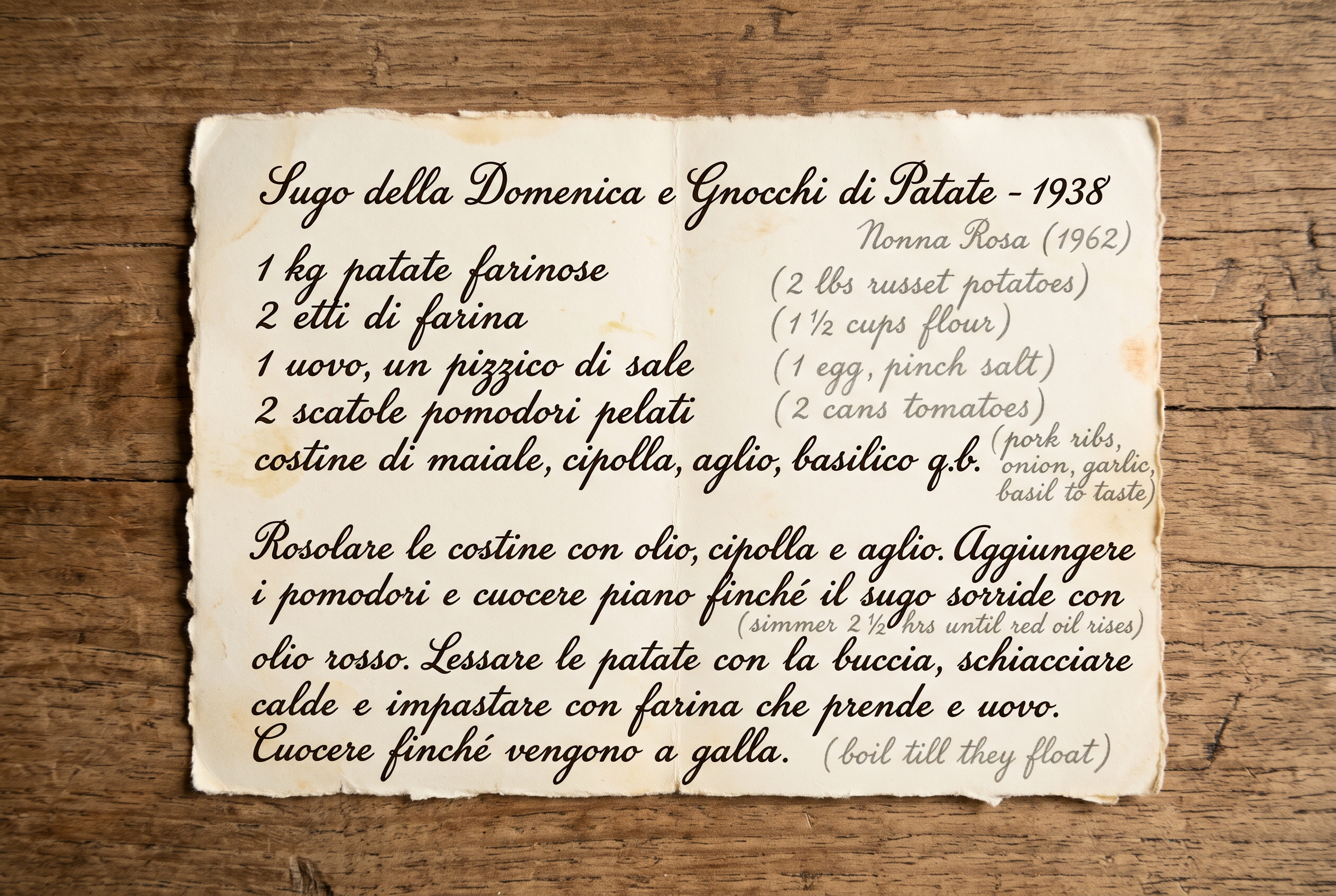
Key Handwriting & Physical Friction Points:
- •Dialect Italian culinary phrases ('q.b.' / quanto basta, 'un pizzico', 'farina che prende')
- •Historical European weight units ('2 etti di farina' = 200 grams / ~1.5 cups)
- •Sprawling Palmer-style cursive with tall ascenders overlapping across lines
- •Sensory cooking directions without timer minutes ('cook until the sauce smiles with red oil')
Historical Provenance & Recipe Origin
When families arrived in North America in the early 20th century, their recipes bridged two worlds. Grandmothers wrote in their native cursive, while daughters added English equivalents decades later. Nonna Rosa's 1938 card featured Abruzzese culinary terms alongside American grocery conversions penciled in 1962.
Unique Hurdles in Immigrant Recipe Preservation
1
2
✨ Bilingual Heritage Translation & Ratio Verification
Unscribble's vision model natively recognizes multilingual culinary vocabulary across European and Latin traditions. It seamlessly parses bilingual cards, preserving the original language in notes while producing clear English instructions.
Step-by-Step Archival Transcription & Digitization Workflow
-
Step 1
Capture Heritage Manuscript
Ensure even lighting across the card so both dark fountain pen and faded pencil annotations are crisp.
Archivist Pro Tip: Include any reverse-side family history written on the card.
-
Step 2
Bilingual Processing
Unscribble automatically recognizes the source language, translates dialect idioms, and standardizes measurements.
Archivist Pro Tip: Check both the translated quantities and original phrasing.
-
Step 3
Archive to Family Box
Save to your cloud collection and share digital copies with cousins and family members across devices.
Archivist Pro Tip: Use the built-in restyle studio to create beautiful heritage food photography.
Nonna Rosa's 1938 Hand-Rolled Potato Gnocchi with Sunday Sugo
🥣 Ingredients
- • 2 lbs russet potatoes, washed whole (unpeeled)
- • 1½ cups Italian Tipo 00 flour (or unbleached all-purpose), plus extra for dusting
- • 1 large egg, lightly beaten
- • 1 tsp fine sea salt
- • Pinch of freshly grated nutmeg
- • 2 tbsp extra-virgin olive oil
- • 1 lb country-style pork ribs or Italian sausage with fennel
- • 1 medium yellow onion, finely minced
- • 2 cloves garlic, sliced
- • 2 cans (28 oz each) whole peeled San Marzano tomatoes, crushed by hand
- • 4 fresh basil leaves
- • Freshly grated Parmigiano-Reggiano for serving
🍳 Preparation & Cooking Directions
- 1 For the Sugo: Heat olive oil in a Dutch oven over medium heat. Brown pork ribs on all sides (8 mins). Remove meat and sauté onion and garlic until soft. Return meat, add crushed San Marzano tomatoes, salt, and basil. Simmer gently over lowest heat for 2.5 hours until pork is meltingly tender and sauce is deep crimson with savory oil glistening on top.
- 2 For the Gnocchi: Boil whole unpeeled potatoes in salted water until easily pierced with a knife (about 30 mins). Drain and peel while still warm.
- 3 Pass warm peeled potatoes immediately through a potato ricer onto a clean wooden work surface. Let steam dissipate for 5 minutes so excess moisture escapes.
- 4 Sprinkle flour, salt, and nutmeg over riced potatoes. Create a well in the center and pour in beaten egg. Gently bring dough together with your hands, kneading just until smooth and pillowy (do not over-work or gnocchi will become gummy).
- 5 Divide dough into 4 portions. Roll each piece into a 3/4-inch rope and slice into 3/4-inch pillows with a bench scraper. Roll each piece gently over a wooden gnocchi board or fork tines to create sauce-catching ridges.
- 6 Bring a large pot of salted water to a gentle rolling boil. Drop gnocchi in batches; cook until they float to the surface (about 60 to 90 seconds), then simmer 1 minute longer.
- 7 Lift gnocchi with a spider strainer directly into warm Sunday Sugo. Toss gently with fresh basil and generous Parmigiano-Reggiano.
Chef Technique & Notes:
- ✓Boiling potatoes in their skins prevents them from absorbing excess water, which is the key to light, tender gnocchi.
- ✓Ricing the potatoes while warm releases steam; letting the steam escape keeps the dough from requiring excess flour.
🏛️ Museum-Grade Physical Paper Preservation Tips
- • Store heirloom immigrant manuscripts in acid-free buffered envelopes.
- • Scan cards at high resolution so calligraphy flourishes remain preserved for genealogy research.
- • Share cloud access with extended family so multiple branches have secure backup copies.