Translating Vintage Recipe Shorthand: Oleo, Butter Size of an Egg & Forgotten Units
Before standardized measuring cups and modern digital ovens, home cooks used relative object comparisons, teacups, and colloquial names. Learn how to convert 'oleo', 'butter the size of an egg', and 'moderate oven' into exact modern baking standards.
📷 Physical Artifact & Archival Condition
Verified Archival Scan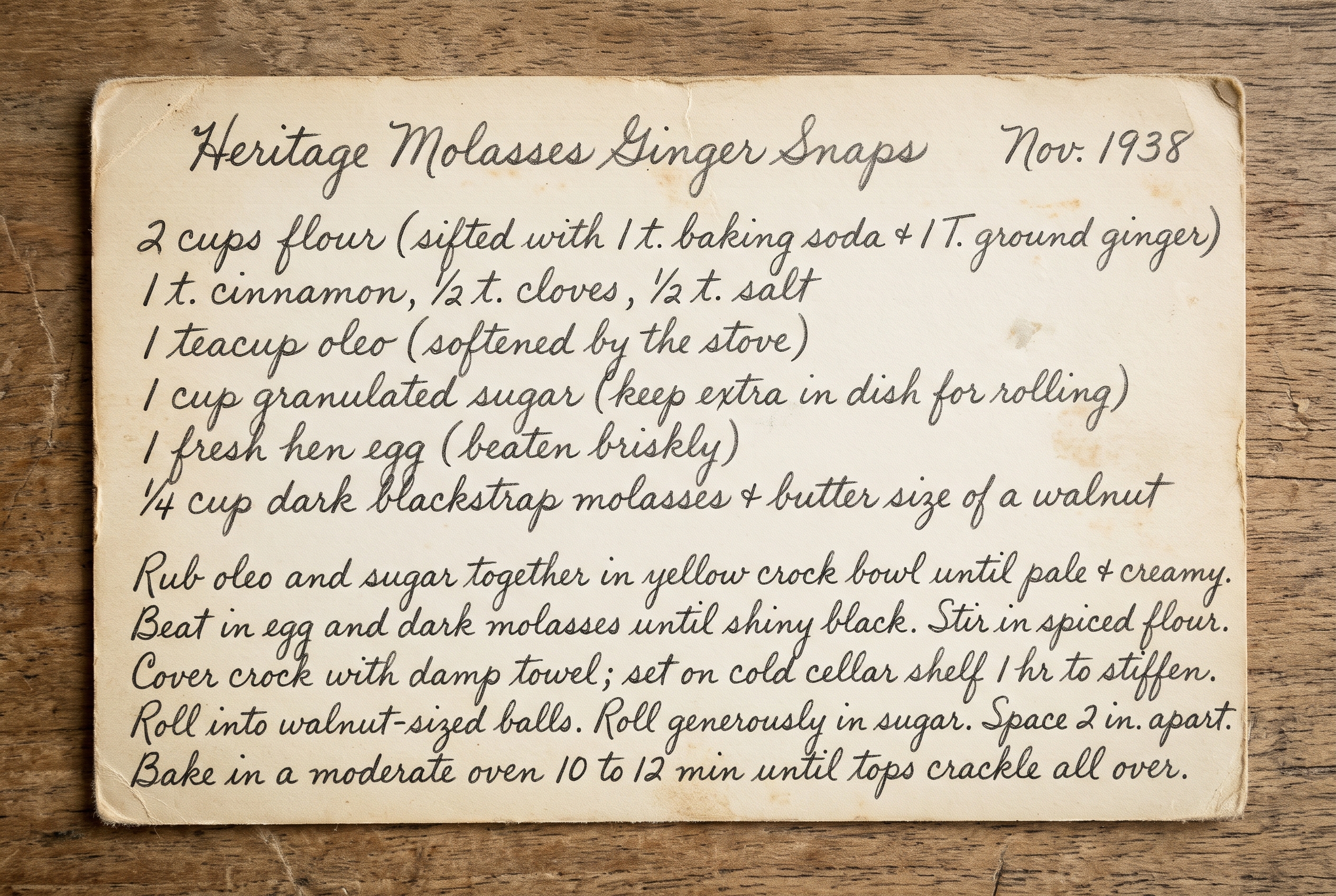
Key Handwriting & Physical Friction Points:
- •Ingredient 'oleo' (oleomargarine) used in place of modern butter or margarine ('1 teacup oleo softened by the stove')
- •Volume measured as '1 teacup oleo' (~6 fl oz instead of standard 8 oz cup)
- •Relative fat quantity specified as 'butter size of a walnut' (~2 tablespoons / 1 oz)
- •Oven temperature described as 'a moderate oven' without numerical degree marking (350°F / 175°C)
- •Cursive shorthand abbreviations: '1 t.' (teaspoon) vs '1 T.' (Tablespoon) and 'fresh hen egg'
Historical Provenance & Recipe Origin
When digitizing recipes written before the 1950s, modern cooks often freeze. What is 'oleo'? How much butter is 'the size of a hen's egg'? And how hot is a 'moderate oven'? In the 1930s and 1940s, standardized Pyrex measuring cups were not in every household. Cooks used common domestic objects and sensory cues. If you attempt to transcribe these cards verbatim without translation, today's home cooks will ruin the recipe.
Quick Vintage Shorthand Translation Key
1 Oleo / Oleomargarine = Butter or Margarine
Oleo was popularized during WWII rationing and the Great Depression as a low-cost butter substitute. For modern baking, replace 1:1 with unsalted butter.
Card Excerpt: “'1 teacup oleo' = ¾ cup (12 tablespoons) unsalted butter.”
2 Butter the Size of an Egg = ¼ Cup (4 tbsp / 2 oz)
A standard hen's egg weighs roughly 2 ounces, which directly equals 4 tablespoons (¼ cup) of chilled butter.
Card Excerpt: “'Butter size of a walnut' = 2 tablespoons (1 oz); 'Butter size of an egg' = 4 tablespoons (2 oz).”
3 Teacup of Flour / Sugar = ¾ Cup (~6 fl oz)
A vintage domestic porcelain teacup held approximately 6 fluid ounces, unlike an 8 fluid ounce standard measuring cup.
Card Excerpt: “'1 teacup flour' = ¾ cup sifted all-purpose flour.”
4 Moderate Oven = 350°F (175°C)
Wood-fired and early gas ranges lacked thermostat dials. Cooks categorized fire heat into slow, moderate, and quick.
Card Excerpt: “Slow oven = 300°F–325°F; Moderate oven = 350°F–375°F; Quick / Hot oven = 400°F–425°F.”
✨ How Unscribble Automatically Modernizes Shorthand
Unscribble recognizes historical ingredients and terminology patterns. When the vision model extracts '1 cup oleo' or 'butter the size of a walnut', it automatically translates the item to modern measurements in the structured ingredients list while preserving the original historical notation in the chef tips and notes sections.
Step-by-Step Archival Transcription & Digitization Workflow
-
Step 1
Scan the Historical Original
Take a sharp photo of the card. Don't worry about faded pencil strokes—Unscribble enhances low-contrast graphite.
Archivist Pro Tip: Natural side-lighting helps reveal faint pencil impressions pressed into aged paper.
-
Step 2
Select Your Preferred Output Style
Choose 'Executive Chef' for standardized culinary grams and volumetric units, or '1950s Heirloom' to keep vintage charm.
Archivist Pro Tip: The Executive Chef style automatically annotates modern doneness temperatures.
-
Step 3
Export & Print 4x6 Cards
Save the digitized recipe to your digital cookbook and print clean 4x6 index cards for your modern kitchen box.
Archivist Pro Tip: Use the built-in PDF Generator to print full-page keepsake cookbook sheets.
1938 Heritage Molasses Ginger Snaps
🥣 Ingredients
- • 2 cups all-purpose flour (sifted with 1 tsp baking soda & 1 tbsp ground ginger)
- • 1 tsp ground cinnamon
- • ½ tsp ground cloves
- • ½ tsp fine salt
- • ¾ cup unsalted butter, softened (originally 1 teacup oleo, softened by the stove)
- • 1 cup granulated cane sugar (plus extra in dish for rolling)
- • 1 large fresh hen egg, beaten briskly
- • ¼ cup dark blackstrap molasses
- • 2 tbsp butter, softened (originally butter size of a walnut)
🍳 Preparation & Cooking Directions
- 1 Whisk flour, baking soda, ground ginger, cinnamon, cloves, and salt together in a medium bowl.
- 2 Rub softened butter (oleo) and sugar together in a yellow crock bowl until pale and creamy.
- 3 Beat in egg and dark molasses until shiny black and glossy.
- 4 Stir in spiced flour mixture until a stiff, aromatic dough forms.
- 5 Cover crock with a damp towel; set on cold cellar shelf (or chill in refrigerator) for 1 hour to stiffen.
- 6 Roll into walnut-sized balls (about 1 inch), roll generously in granulated sugar, and space 2 inches apart on parchment-lined baking sheets.
- 7 Bake in a moderate oven (350°F / 175°C) for 10 to 12 minutes until tops crackle all over and edges are set firm.
- 8 Cool on pan for 5 minutes, then transfer to a wire rack to crisp completely.
Chef Technique & Notes:
- ✓"Moderate oven" in pre-1940s recipes corresponds to 350°F (175°C). "Slow oven" is 300°F–325°F; "Quick oven" is 400°F–425°F.
- ✓Depression-era "oleo" refers to oleomargarine. Using pure butter yields vastly superior modern flavor and crisp crackling texture.
- ✓The card specifies "butter size of a walnut" in addition to oleo—approximately 2 level tablespoons (1 oz / 28g).
- ✓Rolling balls in granulated or coarse sugar creates the signature vintage crackle top with crystalline crust.
🏛️ Museum-Grade Physical Paper Preservation Tips
- • Pencil lasts longer than ballpoint ink: graphite does not fade from UV light or acid degradation like dye-based inks.
- • Handle antique paper with dry, clean hands; avoid cotton gloves which reduce dexterity and cause paper tearing.
- • Keep digitized copies synchronized to Google Drive to ensure heirloom recipes survive fire, flood, or loss.